
Leadership and leadership. Organizations Need Both.
ORGANIZATIONAL
Organizations invest a great deal in Leadership. They define Leadership roles and reporting structures. They establish expectations and job competencies for managers, directors, and executives. They create development programs, succession plans, performance frameworks, and pathways intended to prepare people for increasingly complex Leadership responsibilities.
Those things absolutely matter. But there is another part of the leadership equation that receives less deliberate attention.
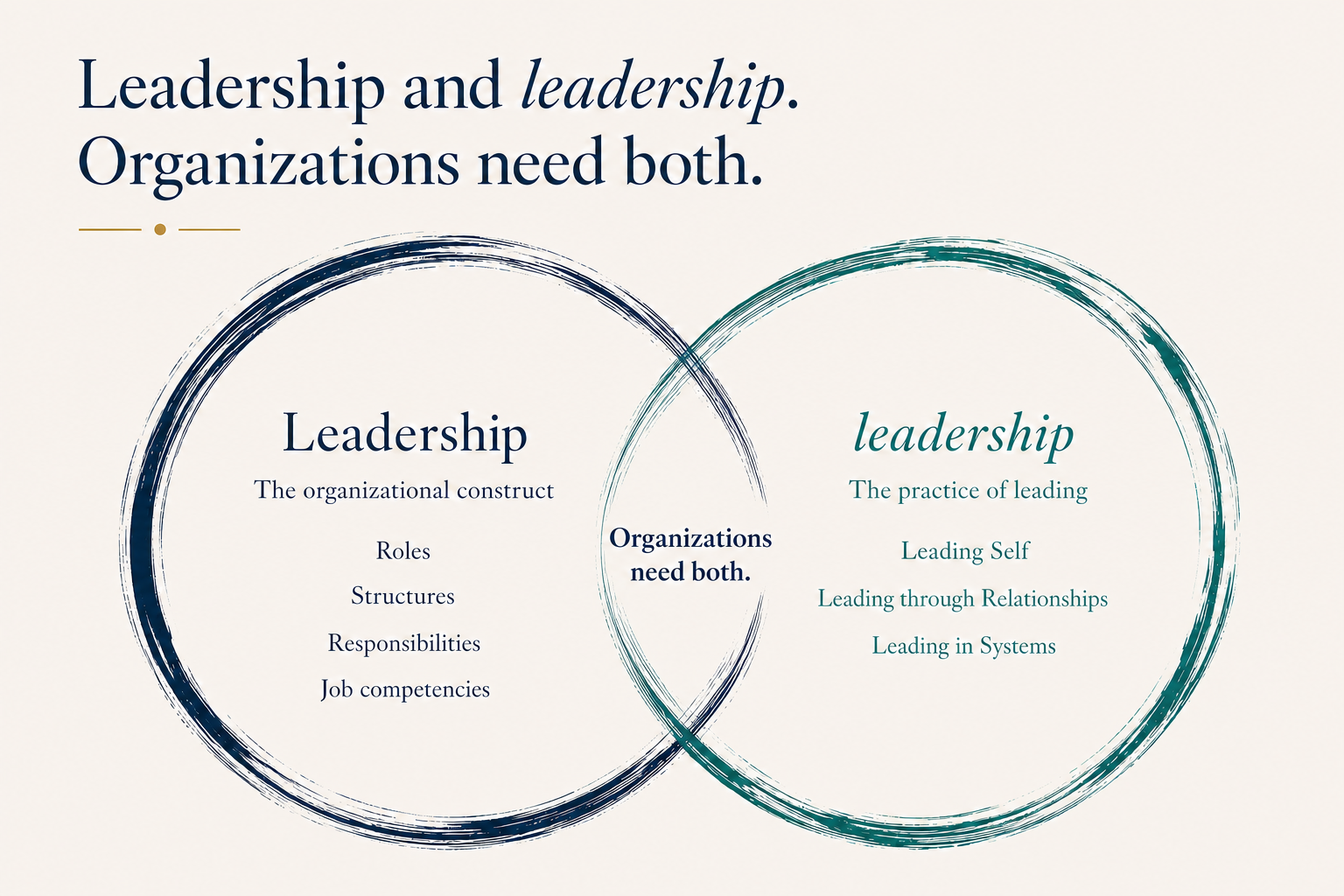
At Sobremesa, we make an intentional distinction between Leadership and leadership.
Leadership is an organizational construct. It describes positions, structures, responsibilities, and the job competencies expected of people who occupy formal Leadership roles.
leadership is the practice of leading. It is expressed through action, in how we choose to lead ourselves, engage with other people, and navigate the systems of which we are a part.
Organizations need both.
Yet while we routinely design structures, roles, competencies, and programs around Leadership, the intentional cultivation of leadership as a practice can be much less visible.
Leadership is bigger than the people with Leadership titles
We often locate leadership within hierarchy. Someone becomes a manager, director, or executive and we begin referring to them as a leader. There is a practical reason for this. Formal Leadership roles are designed to require people to lead. People in these positions are accountable for decisions, resources, teams, performance, and results. Organizations therefore need to define the job competencies required to perform these roles effectively and invest in developing them. Where we can get into trouble is treating the position as evidence that the practice will necessarily follow.
A Leadership role creates responsibility and authority. The practice of leadership requires intention. For the individual, that means choosing to engage in the work of leadership rather than assuming the role itself makes them a leader. For the organization, it means intentionally creating conditions in which that practice can develop. Leadership is rooted in action. It shows up in the choices people make, how they understand and manage themselves, how they engage with others, and how they navigate the systems around them.
That means leadership can happen anywhere in an organization.
A formal leader can practise leadership. So can the person who raises a difficult question when everyone else is silent. The colleague who notices a team is stuck in an unproductive pattern. The employee who gets curious instead of defensive. The person who sees that a recurring problem might be produced by the system rather than by the individual everyone has been trying to fix.
A role can establish someone's authority. It cannot determine their capacity or commitment to lead.
Leadership practice moves
At Sobremesa, we think about leadership practice through three interconnected dimensions.
Leading Self. Leading through Relationships. Leading in Systems.
These are not stages to complete or levels to achieve. They are different lenses through which we can understand and practise leadership. More importantly, leadership moves among them.
A difficult conversation may require us to notice our own reaction, understand what is happening between ourselves and another person, and recognize the organizational dynamics influencing the conversation. A decision that appears operational may require us to examine our own assumptions, engage people with different perspectives, and consider consequences elsewhere in the system.
Leadership is action, and that action rarely stays neatly contained within one dimension of practice.
Leading Self
Leading Self begins with our capacity to notice ourselves.
What am I experiencing? What assumptions am I making? What am I reacting to? What matters to me here? What patterns am I bringing into this situation? What does this situation require of me? Where do I have choice?
Then comes the question of action.
How am I going to navigate what is in front of me? What am I willing to try? Am I willing to be imperfect in service of doing what this moment requires?
Self-knowledge and self-awareness create the possibility of intentional action. Without them, it is remarkably easy to react from habit, emotion, assumption, or a story we have constructed about what is happening. Leading Self doesn't mean perfect self-regulation or endless introspection. It means developing enough awareness of our own experience and our context that we have greater choice in what we do next.
Leading through Relationships
Leadership doesn't happen in isolation. We lead through relationships with people who bring their own experiences, perspectives, assumptions, needs, power, knowledge, and ways of making sense of the world. Those relationships are also how much of the work of leadership gets done. We influence. We build trust. We form partnerships and coalitions. We navigate disagreement. We create the conditions in which people can contribute, challenge, learn, and move together.
Leading through Relationships asks us to get curious about the space between us.
Can we listen without immediately preparing our response? Can we distinguish our experience from someone else's? Can we have a difficult conversation without needing to win it? Can we understand the impact we are having, even when it differs from our intention? Can we stay open to information that challenges what we thought we knew?
Leading through Relationships is not simply about being agreeable or getting along. Sometimes leadership requires disagreement, challenge, boundaries, influence, or saying the thing that would be easier not to say.
The practice is in how we choose to engage.
Leading in Systems
Organizations are systems, not simply collections of individuals. Work moves through structures, processes, relationships, policies, incentives, histories, cultures, and informal networks. Those elements shape how power, influence, information, and work itself move through an organization, often in ways that look quite different from the formal lines on an organizational chart.
Leading in Systems asks us to look through what is immediately in front of us and expand the field of view.
What patterns keep repeating? What connections and structures might be contributing to what we are seeing? What does the organization reward, intentionally or otherwise? How are power and influence shaping what is possible? Where does information get stuck? What are we producing as a system, regardless of what we say we want to produce?
The systems lens does not ask us to put down the lenses of self or relationship. It asks us to look through them and beyond them.
An individual's choices still matter. Relationships still matter. Accountability still matters. But those things exist within a larger context that can reinforce, constrain, enable, or disrupt what happens. Sometimes the most useful leadership action is not fixing the person or solving the immediate problem. It is becoming curious about why the same problem keeps appearing.
Organizations can provide excellent Leadership development but leadership development doesn't end when the program does. A well-designed program can introduce new concepts, build self-awareness, offer useful tools, create relationships, challenge assumptions, and give people a different way of understanding their role.
Those are important foundations. But a foundation is not a practice.
The development of leadership practice is iterative, experiential, and contextual. We develop our capacity to lead by trying to lead in the circumstances where leadership is actually required.
The practice emerges through the difficult conversation, the decision with incomplete information, the meeting where power is shaping what can and cannot be said, the moment when our first instinct is to react, the problem that doesn't have an obvious answer, and the realization that something we tried didn't have the impact we intended.
These are not interruptions to leadership development. They are where leadership development happens. The question is whether the organization creates the conditions for people to learn from them.
What does your culture make possible?
An organization can say that leadership matters while unintentionally creating conditions that make leadership practice difficult.
If every available minute is consumed by deliverables, when does reflection happen?
If mistakes are met primarily with blame, how willing will people be to experiment?
If disagreement carries interpersonal or professional risk, how likely are people to raise the difficult question?
If people are rewarded only for what they produce, what signals are being sent about the time they spend developing others, building relationships, reflecting, learning, or challenging an ineffective pattern?
If leadership development happens primarily inside a classroom or program, what supports people when they return to the complexity of their everyday work?
Culture is not simply what an organization says it values. Culture is also revealed through what people experience as safe, expected, rewarded, discouraged, possible, and worth making time for. Organizations where leadership practice flourishes intentionally create a culture of leadership.
They create room for reflection and learning. They support peer learning, mentoring, coaching, and communities of practice. They pay attention to leadership in performance and development conversations. They give people opportunities to experiment, notice what happens, learn, and try again. They also invite people to lead.
That invitation matters. Formal leaders can create opportunities for people throughout an organization to exercise judgment, contribute perspective, challenge assumptions, influence direction, and take meaningful responsibility. Regular conversations can make room not only for the business of the work, but also for the practice of leadership within it.
This is part of the idea at the heart of Sobremesa.
Sobremesa is a Spanish word for the time spent lingering together at the table after a meal. The dishes may still be on the table, but the business of eating has finished. What remains is space for conversation, connection, reflection, and ideas that have room to emerge because no one is rushing immediately to the next thing.
Organizations need those spaces too.
Not necessarily around a literal table, and not necessarily separated from the work. They need cultures in which reflection, exploration, connection, and growth are understood as part of the work. That is where leadership practice has room to develop.
Leadership and leadership. A both, and proposition.
Organizations need Leadership. They need clear roles, sound structures, appropriate accountabilities, and people with the job competencies required to manage teams, resources, operations, and organizational responsibilities effectively.
And organizations need leadership. They need people who can lead themselves with intention, work through relationships with curiosity and courage, and see and navigate the systems in which their work occurs.
One does not replace the other.
The opportunity is to stop assuming that investing in Leadership will, by itself, produce leadership.
A culture of leadership practice requires intention. People need to be invited, supported, challenged, and expected to practise. They need opportunities to try, reflect, learn, refine, and try again. And that practice cannot belong only to people with Leadership titles or exist only inside Leadership programs.
Leading Self.
Leading through Relationships.
Leading in Systems.
Again and again, in the context of the work itself.
Most organizations already invest in Leadership. The opportunity is to become equally intentional about creating the culture in which leadership can grow.
Interested in creating more space for leadership practice in your organization?
Sobremesa works with organizations to create thoughtful, context-specific leadership development experiences that strengthen the practice of Leading Self, Leading through Relationships, and Leading in Systems.