
Career Advancement Doesn’t Always Mean Moving UP
CAREER | LEADERSHIP
Sometimes the most important career move is the one that changes what you can see from where you stand.
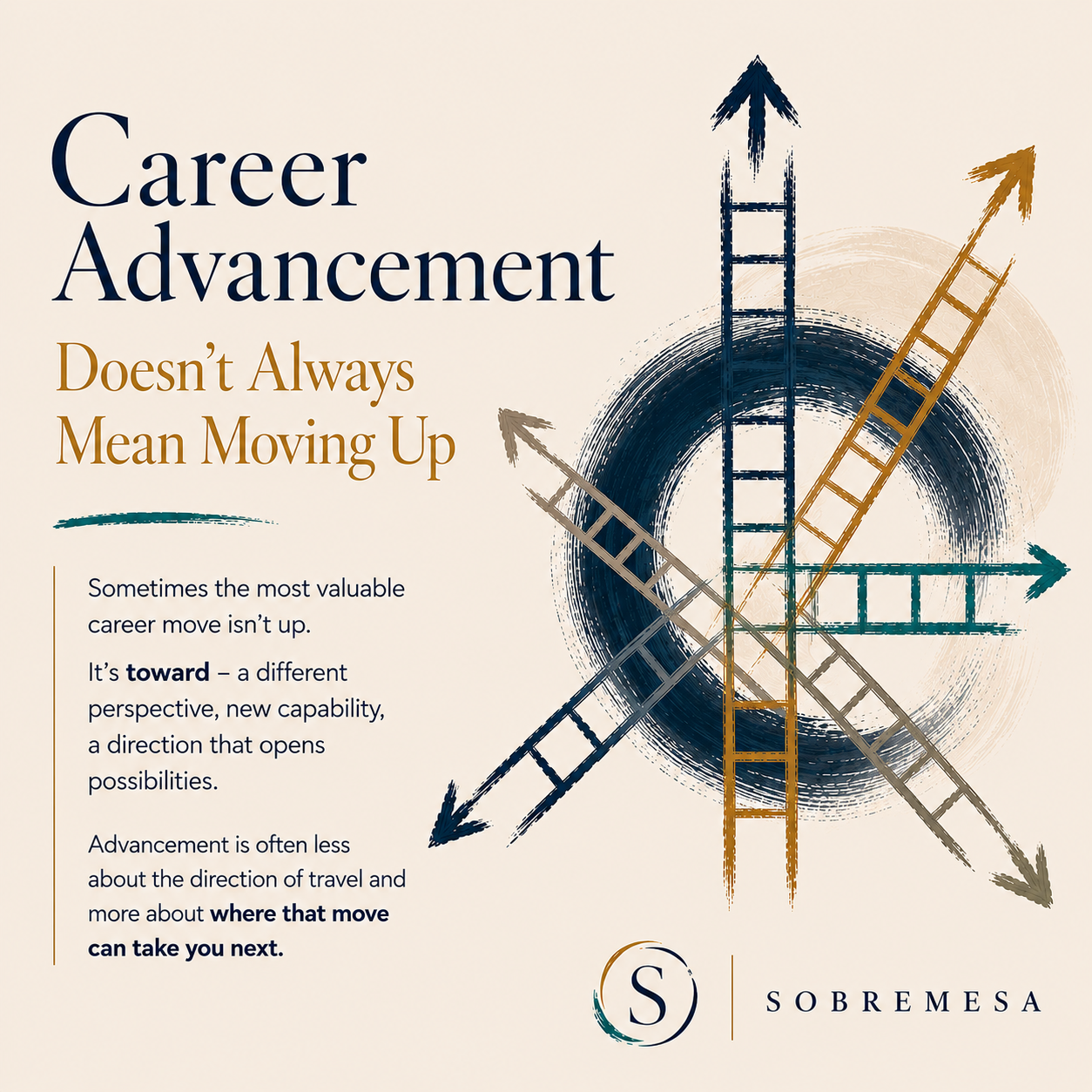
We often talk about career advancement as though its direction is obvious. A more senior title, greater responsibility, increased authority, better compensation or a larger team can all be signs that a career is progressing. We climb the ladder, move through the ranks and, ideally, arrive somewhere that looks and feels like success.
There is nothing wrong with that path. For many people, moving upward is exactly the kind of advancement they are looking for. But it is not the only way a career can move forward. Focusing too narrowly on the next rung of the ladder can make it difficult to recognize opportunities that do not immediately look like advancement at all.
Sometimes the move that changes a career most is sideways. Sometimes it asks us to give something up. Sometimes we don't know where the move leads.
When the next step isn't up
I started my career in nursing, providing direct care to critically ill patients. At the time, the career path I imagined was fairly straightforward. I wanted to care for the sickest patients, become increasingly skilled at doing it and, eventually, perhaps become a charge nurse. That was about as far as my imagination had taken me.
I found enormous meaning in bedside nursing, and I want to be careful not to diminish the contribution made there. The work mattered to patients and their families, to my colleagues and to the communities we served. At the same time, I was beginning to recognize patterns in some of the frustrations my colleagues and I talked about repeatedly. We could see challenges in how care was organized and delivered, and we could certainly see their impact. I increasingly found myself wondering how the voices and perspectives from the bedside could reach the places where decisions were being made.
I did not yet have the language to describe what I was looking for. I certainly was not thinking about "system-level impact." I simply had a growing sense that there might be another way for me to contribute, and I became curious about what that could look like.
Around that time, I heard about an opportunity in Clinical Informatics, an emerging area of practice that brought healthcare professionals into work focused on how technology, information and clinical practice come together to support the delivery of care. The role would take me away from the bedside and, like many nurses at the time, I did not know much about the field. I did some research, asked questions, talked to people who knew more than I did and eventually decided to apply.
When I accepted the position, it would have been difficult to describe the move as upward on a conventional career ladder. I was leaving an area where I was seen as having potential to advance and giving up the financial premiums that came with long shifts, nights, weekends and working in a high-demand clinical environment. I was moving instead into an emerging field that was unfamiliar enough that some people did not recognize it as an area of nursing practice at all.
Understandably, people had questions and opinions about the decision. Some were thoughtful and some were less kind. Many echoed questions I was already asking myself. What was I walking away from? Would I lose my clinical skills? Could I return to bedside practice one day? Was I wasting my education or the skills I had worked so hard to develop? Would this turn out to be the right move? And where, exactly, could I go from there?
I did not know the answers to most of those questions. What I did know was that I wanted to understand more about how healthcare worked beyond the point where an individual patient and clinician met. I wanted to learn more about the machinery of the health system and explore whether I could contribute not only to the delivery of care, but also to changing how that care was delivered.
So I took what looked, by some measures, like a lateral step and, by others, perhaps even a step backward.
A different view
What happened next was not that I suddenly discovered the career I was meant to have. The change was much less tidy than that. What changed first was what I could see.
That new role exposed me to parts of healthcare I had barely known existed. I encountered nurses, occupational therapists, respiratory therapists, dietitians and other health professionals working in roles I had never imagined for myself or, in some cases, even known were available. I watched clinicians stand at the front of large rooms as respected experts, advocating for system-level change. I saw project managers, sometimes clinicians themselves, leading complex, multimillion-dollar initiatives with the potential to influence care for years to come.
I also began participating in conversations I had never encountered at the bedside. I learned about technology implementation, capital and strategic planning, organizational investment, government priorities and the ways large healthcare organizations interpret and respond to them. As I moved through different projects, roles, and responsibilities, I found myself tackling increasingly complex problems with progressively broader reach.
None of that erased the nursing career that I started with. My clinical experience came with me. What changed was what began to accumulate around it. I added new knowledge, skills, relationships and perspectives to the ones I already had, and those additions gradually changed both what I was capable of doing and what I could imagine doing next.
Just as importantly, making one uncertain career decision made later ones feel more possible. Once I had experienced my professional identity stretching without disappearing, the boundaries around what I imagined I could do became less rigid.
It would be tempting, looking backward, to tell this story as though I had recognized an unconventional route to the career I have today. I had not. There was no five-year plan pointing me toward a particular role, and I could not have described the career that would eventually emerge. I had something much less precise. I knew I wanted to contribute differently, and I was curious enough about what might be possible to take a thoughtful step in that direction.
Direction without a destination
We put a great deal of pressure on people to know where their careers are going. We ask where they want to be in five years, what role they want next and what their ultimate career goal might be. These can be useful questions, particularly when there is a clear destination someone is working toward. They can also create the impression that a meaningful career decision requires us to know exactly where it will lead.
Sometimes we do not know the destination yet. What we know is something about the direction.
Perhaps you want to have a different kind of impact or greater autonomy in your work. You may want to deepen your expertise without managing people, or you may be curious about a part of your organization or industry that you have never had an opportunity to understand. You might want to develop capabilities your current role cannot give you. Your life outside work may have changed what you need from your career. Or perhaps you simply have a persistent sense that you want something different before you have the language to explain what that difference is.
Not knowing the destination does not necessarily mean you are directionless. Sometimes the more useful question is not What job do I want next? but What am I trying to move toward?
What does advancement mean to you?
The traditional career ladder gives us a particular set of measures for evaluating an opportunity. We can ask whether the title is more senior, whether the position pays more, whether it carries greater authority or whether other people will recognize it as progression. These are legitimate considerations. Compensation matters. Responsibility and authority can matter. For some people, status matters too. There is nothing wrong with any of that.
They are simply not the only measures available to us.
An opportunity might advance your career because it gives you access to a capability you do not yet have, a perspective you cannot gain from where you currently sit or exposure to another part of a system. It might connect you with people you would not otherwise encounter, allow you to test something you have been curious about or give you experience that becomes relevant several moves from now. Sometimes its value is simply that it teaches you more about what you do, or do not, want.
A lateral move may create more future possibility than an immediate promotion. Moving into management may be exactly the right next step for one person, while deciding not to become a manager may be an equally intentional choice for someone else. An opportunity that makes little sense when plotted on a traditional career ladder may look quite different when considered in relation to the capability, contribution and life someone is trying to build.
Perhaps career advancement is less about the direction of a particular move and more about whether that move helps us develop, contribute and create meaningful possibilities for what comes next.
Moving thoughtfully doesn't require certainty
None of this means that every unconventional opportunity is worth pursuing or that uncertainty should be romanticized. There were real trade-offs in my decision to move away from bedside nursing, and the people who raised questions about them were not necessarily wrong.
In fact, for a variety of reasons, I later returned to bedside practice for a period of time. I did not return as exactly the same nurse who had left. I brought with me new skills, experiences and a different understanding of the system around the care I was providing. That perspective helped me notice opportunities and possibilities I may not previously have recognized as available to me.
Careers do not always unfold in a clean sequence, and an experiment does not have to become permanent to have value.
A new opportunity may mean less money, less security, a loss of status, unfamiliar work or a steeper learning curve. It may close some doors while opening others, and there is always the possibility that the experiment will not work in the way we hope. Thoughtful career navigation does not require us to ignore those risks. It asks us to consider them alongside what might become possible.
What could I learn here? What might I be able to see from this vantage point that I cannot see from where I am now? What capabilities could I develop? What possibilities might this create? What am I giving up, and can I live with that trade-off?
Perhaps the most important question is whether the move takes you toward something that matters to you.
You may not know where the second, third or fourth step will lead. But sometimes there is enough information in the direction to take the first one.
Career moves can be an act of leadership
We often think about leadership in relation to how we engage with or influence other people, but leadership also has something to do with the choices we make about our own direction. This does not mean that every career decision is an act of leadership, or that choosing an unconventional path is inherently more courageous or worthwhile than following an established one.
There can, however, be leadership in noticing that something no longer fits, becoming curious about another possibility and being willing to examine what that curiosity might be telling us. There can be leadership in listening carefully to the advice and concerns of others without surrendering our own judgment, and in considering the consequences of a decision while accepting responsibility for the choice we ultimately make.
Sometimes leadership looks like taking a thoughtful step toward something that matters before we can see exactly where the path ends.
Career advancement does not always mean moving up. It can mean moving sideways, going deeper, stepping into unfamiliar territory or deliberately building a capability that will not pay off immediately. Sometimes the most valuable thing a career move gives us is not a better position at all. It is a different vantage point from which we can see possibilities that were previously outside our field of view.
So perhaps, alongside asking What is my next step up?, there is another question worth considering.
What direction am I trying to move in, even if I cannot name the destination yet?
My experience is only one version of what a less obvious career path can look like. I suspect some of the most useful career wisdom comes from the moves that made more sense in hindsight than they did at the time.
What's the best career move you've made that didn't look like advancement when you made it?