
Your Résumé Isn’t Your Career History
CAREER DEVELOPMENT
Writing a résumé can feel a lot like documenting your career history. You start with where you have worked, add your job titles and dates, describe what you were responsible for, and try to fit everything important onto two pages.This approach makes total sense. A résumé looks a little like a career history. It has dates, employers, job titles, education, and accomplishments arranged in roughly chronological order.
But that isn't really what a résumé should be.
Your résumé shouldn't be an inventory of everything you've done. It should be a deliberately designed argument about what you can contribute in the role you are pursuing.
That distinction matters.
Your employment history is only one part of your experience
When we approach a résumé as a historical record, we tend to work job by job. What was my title? What were my responsibilities? What tasks did I perform?
Answer those questions and you can end up with something that looks remarkably similar to a collection of your old job descriptions. The result may be accurate, but it isn't particularly useful.
A job description from a previous role tells a prospective employer what someone in your position was expected to do. It doesn't necessarily tell them what you did with the opportunity. And for people with limited formal employment history, starting with jobs can create an entirely different problem. There may not be much employment history to work with yet.
Experience and employment are not the same thing.
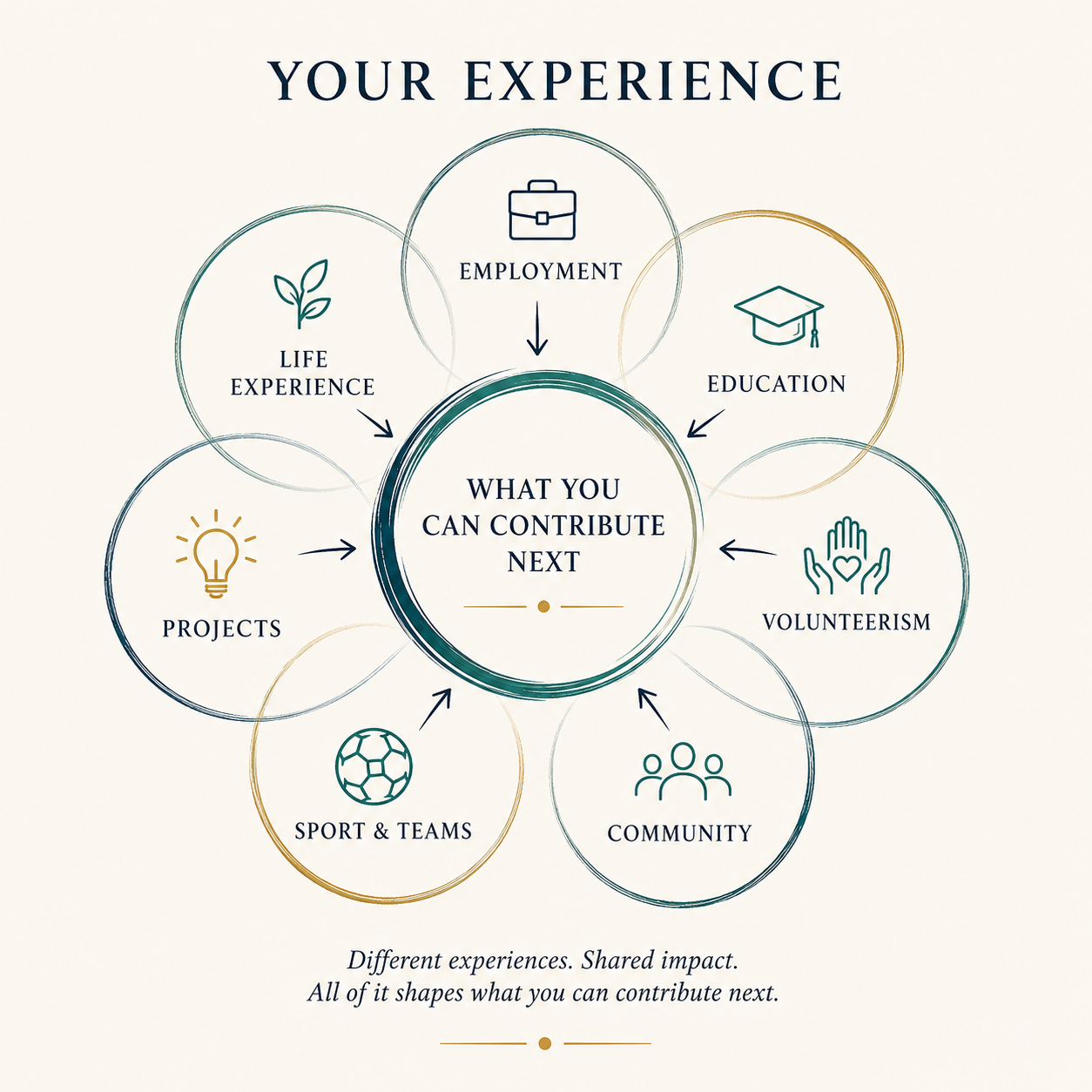
We develop and demonstrate capability in all kinds of places. Volunteer organizations. Community groups. Team sports. School. Committees. Clubs. Creative pursuits. Projects. Caring for others. Sometimes even the things we simply stepped forward and took responsibility for because somebody needed to do them.
A volunteer may have coordinated an event, recruited people, managed a budget, solved an unexpected problem, or built relationships across a community. An athlete may have developed discipline, learned to work within a team, mentored younger players, navigated conflict, or taken on an informal leadership role. A student project may have required research, analysis, presentation, collaboration, planning, and meeting a difficult deadline.
None of that should be exaggerated into something it wasn't. But neither should it be dismissed simply because nobody paid you to do it.
Being creative about your experience doesn't mean being creative with the truth. It means looking more broadly for evidence of what you can do and connecting that evidence to what a prospective employer is looking for.
Start with contribution, not responsibility
Whether you have two years of experience or 20, one of the most useful shifts you can make is to:
Stop asking only
What did I do?
And start asking
What did I contribute?
Those aren't quite the same question.
Consider the difference between saying you were responsible for coordinating a project and explaining that you coordinated people from several teams to deliver a project on time despite competing priorities. The first describes an assigned responsibility. The second begins to tell us something about you.
This doesn't mean every bullet on your résumé needs a percentage, dollar value, or dramatic achievement attached to it. Not all valuable work can be reduced to a metric. Contribution might be something you improved, built, solved, influenced, organized, stabilized, introduced, simplified, learned, or helped others accomplish.
The goal is to help the reader understand what happened because you were there.
A good résumé is selective
This is where treating a résumé like career history becomes particularly troublesome for experienced professionals. After 10, 15, or 25 years, there is simply too much. Trying to include everything can actually make your strongest experience harder to see.
A résumé should be truthful and representative, but it does not need to give every experience equal weight. What you choose to include, how much space you give it, and what you emphasize should depend on the opportunity you're pursuing. That means two résumés based on exactly the same career can legitimately look different.
If you're pursuing a more senior role, you might emphasize strategic decision-making, influence, complexity, leadership, and organizational impact.
If you're moving into a different industry, you might look for capabilities that transfer across settings. Perhaps you have managed complex projects, built client relationships, analyzed information, improved processes, or worked effectively with different groups of people. The context may be changing, but the capability travels with you.
If you're early in your career, the evidence may come from somewhere other than paid employment. Organizing a fundraiser might demonstrate planning and coordination. Serving on a student council might show collaboration and advocacy. Playing competitive sport might offer evidence of teamwork, discipline, or resilience.
The history hasn't changed. The story you're asking the reader to notice has.
The job description is a guide, not a script
If your résumé is making an argument about your fit for a particular opportunity, you need to understand what that opportunity is asking for. This is where the job description for the role you are applying for becomes useful. Read it for more than keywords. Look for what seems to matter to the employer. What responsibilities appear central to the role? What capabilities are they asking for? What problems might this person be expected to solve? What experience do they value?
Then look back across your own experience.
Where have you demonstrated those capabilities? What examples provide the strongest evidence? What should receive more attention on this particular résumé because it matters to this particular opportunity? This doesn't mean copying language from the posting or trying to make yourself appear to be a perfect match for every requirement. It means using the information available to you to make thoughtful choices about what you present.
Your résumé should be tailored to the opportunity, not treated as a one-and-done document that tries to say everything to everyone.
Look backward with a reason
A résumé is necessarily built from the past, but its purpose is forward-looking. You're not documenting your career for an archive. You're helping a prospective employer decide whether what you've done and learned might be valuable in the role they need to fill.
So before deciding what belongs on the page, it helps to know what you're trying to demonstrate.
What does this opportunity require?
What is this employer asking the successful candidate to take on?
What capabilities would allow someone to be successful?
Where, across the full breadth of your experience, have you demonstrated those capabilities?
And what evidence can you offer?
Those questions change résumé writing from transcription into interpretation. They also make it easier to decide what doesn't need to be there.
An accomplishment can be significant and still not be particularly relevant to the opportunity in front of you. Conversely, an experience you have barely thought about in years may suddenly become highly relevant when viewed in the context of a particular role.
Give your experience, and yourself, some credit
There is an interesting challenge that appears at both ends of the experience spectrum. People early in their careers can underestimate themselves because they haven't accumulated enough job titles yet. People with long careers can underestimate themselves because capabilities developed over many years have become so familiar that they no longer seem noteworthy.
In both cases, writing a strong résumé requires curiosity. It also takes a little courage. There can be discomfort in saying clearly that you are good at something. It can feel boastful to claim an accomplishment, name a strength, or articulate the value you created. But a prospective employer cannot give you credit for something you are unwilling to tell them.
Look at your experience again.
Not just at where you worked, but at what you learned to do. What people relied on you for. The problems you were repeatedly asked to solve. The situations you learned to navigate. The things you made better. The responsibilities you chose to take on. The moments when you stretched beyond what you already knew how to do.
Pay particular attention to the things that feel ordinary to you. The skill you use without thinking. The responsibility that simply became part of your day. The problem people routinely bring to you because they know you can solve it.
What feels unremarkable from inside your own experience may be evidence of a capability that matters very much to someone looking for it.
Your résumé has a job to do
Ultimately, a résumé is a marketing document. That doesn't mean embellishing your experience or turning yourself into something you're not. It means understanding that your résumé has a specific audience and a specific purpose. It should help a prospective employer understand what you bring to the table relative to the role they are trying to fill. And you are rarely the only person asking for their attention.
A hiring manager may be reviewing dozens, or even hundreds, of applications. Your job is not to hand them your entire history and hope they find the parts that matter. Make the connection easier to see. Decide what matters for this opportunity. Draw the connections. Provide the evidence. Help them understand not only where you've been, but what your experience has equipped you to do and why that matters for the role in front of them.
Your employment history tells them where you've worked. Your résumé should help them understand why your experience matters and what you might be able to do with it next.
CAREER SERVICES
Need help seeing the story in your own experience?
Sobremesa Career Services can help you identify what you bring to the table, connect your experience to where you want to go next, and build a résumé that makes that value clear.